Haslemere’s Grade II Listed Signal Box

IMG_8356Control of colour lights by traditional lever frame is a reasonably common feature of Britain’s signalling infrastructure, but few signal boxes can surely match Haslemere, where 2018 marks 81 years since replacement of its semaphore signals by colour lights in 1937, to coincide with electrification of the Portsmouth Direct Line.
Haslemere is one of only three surviving signal boxes on the route, the others being at Farncombe and at Petersfield, with the latter also being Grade II Listed. What makes Haslemere unique among this trio, however, is in retaining its complete and original 47-lever frame, controlling signals and points between Liphook and Witley. Continue reading “Haslemere’s Grade II Listed Signal Box”

Favourite photo-spots: Westbury

IMG_8261

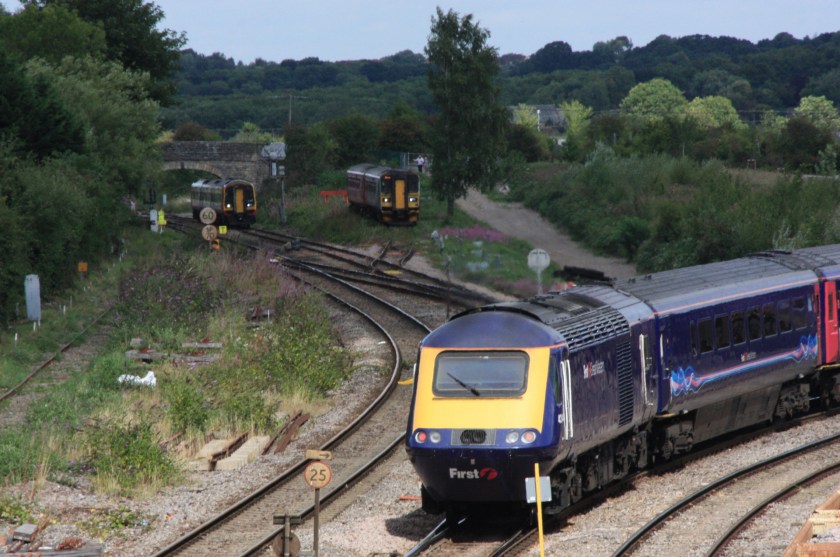
For variety of passenger and freight traction, there can be few places in the South of England to match Westbury, a small and unremarkable Wiltshire town best known for its White Horse, carved into the chalk hillside overlooking the town.

Westbury stands 109 miles from London Paddington and is a major junction on the Berks & Hants route via Newbury to the South West, being the point where it crosses the busy Bristol to Portsmouth line, while other services run from here to Swindon via Melksham.

Add the regular stone traffic originating at the nearby Merehead and Whatley quarries, and you are in for pretty much non-stop action on an average weekday, with the three hours I spent there on Friday (17 August) producing no less than five different classes of passenger unit and three different classes of freight loco. Continue reading “Favourite photo-spots: Westbury”

Waiting for that weekday train to Okehampton

IMG_8078Okehampton is one of those places where the argument for reinstating train services seems to have been won in spades, yet time marches on and, in spite of the right noises being made, nothing actually seems to happen.
For more than two decades the residents of this Devon town, and those wishing to sample tourist attractions, like the Granite Way path leading south over the Grade I Listed Meldon Viaduct, have been tantalised by a seasonal service on one day a week. Continue reading “Waiting for that weekday train to Okehampton”

Lymington branch – then and now

IMG_8037
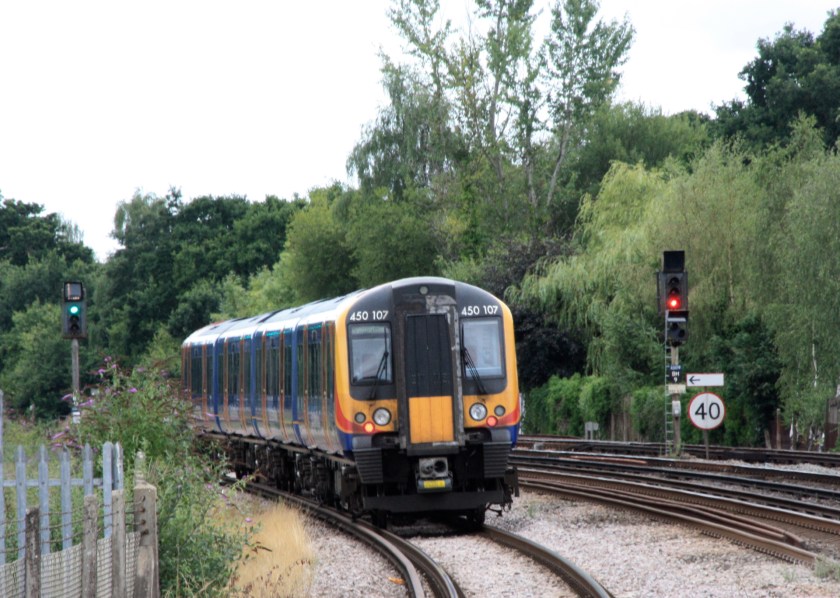
Returning to the 5¼-mile Lymington branch line this weekend, almost a decade after the end of heritage traction, I was interested to see how the designated community railway had fared in the absence of the slam-door stock that had made it an enthusiast mecca from 2005 until May 2010.

When the two 3-CIG slam-door units were finally stood down there were not sufficient electric units to replace them, so the line is worked from Mondays to Fridays by a Class 158 diesel unit and only sees electric traction at week-ends, when services are in the hands of a Class 450 Desiro unit. Continue reading “Lymington branch – then and now”

Railway rambling in Snowdonia

IMG_1899
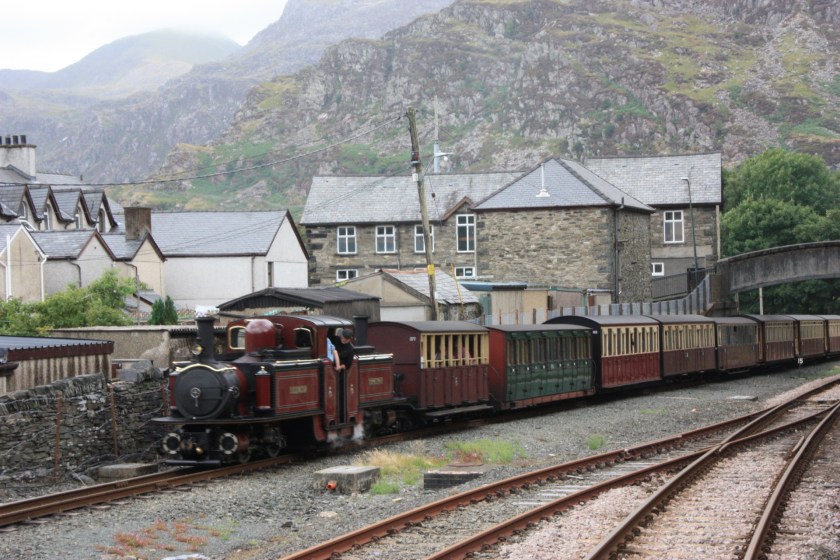
Membership of the Welsh Highland Railway Society (WHR Society) must rank as one of the greatest British travel bargains, since it offers a year’s free travel on this remarkable 25-mile long line for less than the cost of just one full round trip.

The annual fee of £39.00 compares to a Porthmadog-Caernarfon return fare of £39.80, with members not only getting unlimited free travel on Britain’s longest narrow gauge railway, but also three privilege rate (66% discount) tickets for family or friends and unlimited privilege rate travel on the Ffestiniog Railway. Continue reading “Railway rambling in Snowdonia”

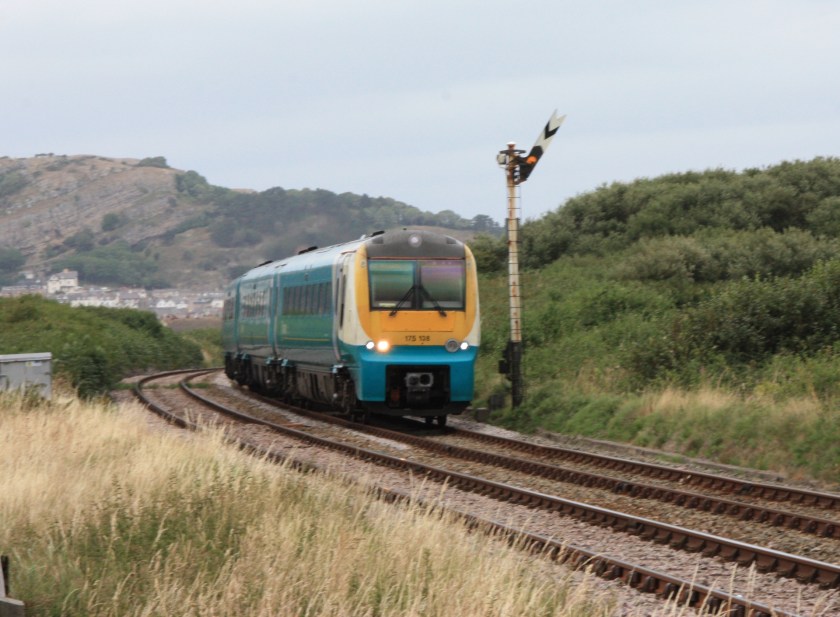
Favourite photo-spots: Llandudno & Deganwy

IMG_2013
Re-signalling along the North Wales coast earlier in the year (see my posts on Rhyl, Abergele and Prestatyn) means mechanical signalling in the area is now confined to Anglesey on the main line and to three locations on the delightful Conwy Valley Line from Blaenau Ffestiniog to Llandudno.

On the branch proper, the remaining signal box at North Llanrwst controls four semaphore signals and the only passing loop on this line, while at the northern end of the route there is an interesting outpost of mechanical signalling between Deganwy and the seaside terminus at Llandudno, 1¾ miles to the north.

Llandudno Station Signal Box is an impressive structure dating from 1891 that, like so many others, has been ruined by the replacement of its traditional glazing with uPVC windows. It controls movement in and out of the three platforms, and the notable feature here is the gantry at the exit from platforms 1 & 2, with shunting arms alongside each of the starting signals, and another alongside the platform 3 starting signal. Continue reading “Favourite photo-spots: Llandudno & Deganwy”

Dudding Hill freight action

IMG_1672Photographing trains on the Dudding Hill Line is no easy matter. For a start services on north-west London’s Cinderella route are few and far between, but then the combination of extensive line-side vegetation and high bridge parapets makes decent vantage points very hard to find.

As a reminder to those who may have missed my September 2017 post “Dudding Hill: the line that time forgot”, this is a four-mile long route from Acton to Cricklewood that is controlled by three mechanical signal boxes, and has a ruling 30mph speed restriction. It is a line which lost its passenger services in 1902 and has somehow missed out on the highly successful expansion of London’s Overground network. Continue reading “Dudding Hill freight action”

Favourite photo-spots: Brundall

IMG_1513Re-signalling of the Wherry Lines from Norwich to Great Yarmouth and Lowestoft continues apace – with “bagged lollipops” having already appeared at a number of locations, so after previous looks at Reedham and Oulton Broad North, it is time to pay a visit to the third mechanically-signalled junction on this fascinating network.

Brundall station stands 5¾ miles east of Norwich and is the point where a single line to Great Yarmouth via Acle diverges from the double track route to Lowestoft. It is served by hourly trains on the Acle line and by some, though not all, of the Lowestoft services. Continue reading “Favourite photo-spots: Brundall”

Third rail’s missing link

IMG_1356Chaos at Waterloo on the evening of Wednesday 18 July 2018 (body on the line at Clapham Junction apparently) and an invitation for passengers to take any reasonable route to get to their destination found me travelling to East Croydon and then Reigate, on my near four-hour trek home to Haslemere.

Apart from discovering that beer in the charming Prince of Wales pub is outrageously expensive (£4.70 a pint), it also reminded me what an absurd world we live in, when Reigate marks the end of the line for third rail operation – as it has for the past 85 years – and continuing west from here requires change onto one of the busy Gatwick Airport to Reading diesel-operated services. Continue reading “Third rail’s missing link”

Summer Saturday at Yeovil Pen Mill

IMG_1293Weymouth remains a great magnet for day trippers and holidaymakers, so on the first Saturday proper of the summer holidays, and with the added bonus of seafood festival, there was bumper traffic to the resort from Yeovil Pen Mill on 14 July 2018.

IMG_1158In less than 90 minutes during the mid-morning there are four services to the resort from Pen Mill, including the highly popular 09.50 SWR service from Basingstoke where three coaches of its five-car formation continue to Corfe Castle on the Swanage Railway (described in my earlier blog post). Here 158886 + 159014 (rear) depart for Weymouth and Corfe Castle. Continue reading “Summer Saturday at Yeovil Pen Mill”